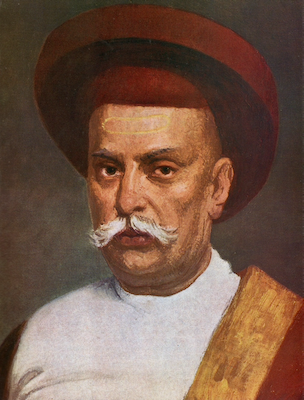
The Man Mumbai Forgot
The life, reform, and legacy of Jagannath Shankarshet (Sunkersett) (1803–1865).
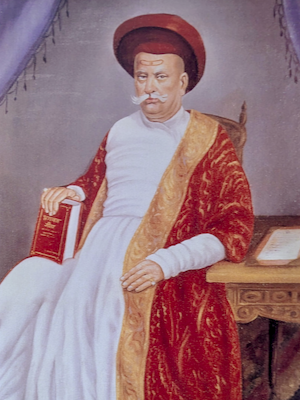
Jagannath Shankarshet, c. 1863
There is a bust on the front of Chhatrapati Shivaji Maharaj Terminus. Around three million people pass under it every day. Almost none of them look up, and almost none of them could tell you whose face it is.
It is the only Indian face on that building.
He was called Nana. He was born in Bombay in 1803, when it was still a swampy cluster of islands where Englishmen joked that a newcomer's life should be measured in monsoons. He died in 1865, and the city closed — schools, offices, markets, mills — while fifteen thousand people walked behind his body from Girgaon to Sonapur.
Then Mumbai forgot him almost completely.
“He didn't build monuments. He built institutions.”
He built the city's nervous system
Most rich men who love a city give it a building. Nana gave it a nervous system.
Walk through South Mumbai and you are walking through his decisions. Grant Medical College. Sir J.J. School of Art. Elphinstone College. The University of Mumbai. India's first law college. The Bombay Native Dispensary — the city's first public clinic. Its first maternity hospital. Rani Baug and the museum beside it. The Asiatic Society's library, stocked partly with books he paid for.
And the railway. On 16 April 1853, India's or rather Asia's first train ran from Boribunder to Thane, and Nana was on it — because he had spent a decade making it happen, starting a company for it in 1843, before anyone in London had thought of the idea. When the engineers arrived from England and had nowhere to work, he gave them rooms in his own house.
Nearly everything on that list is still running, 160 years later. Your doctor may have trained at Grant Medical College. Your commute runs on his railway.
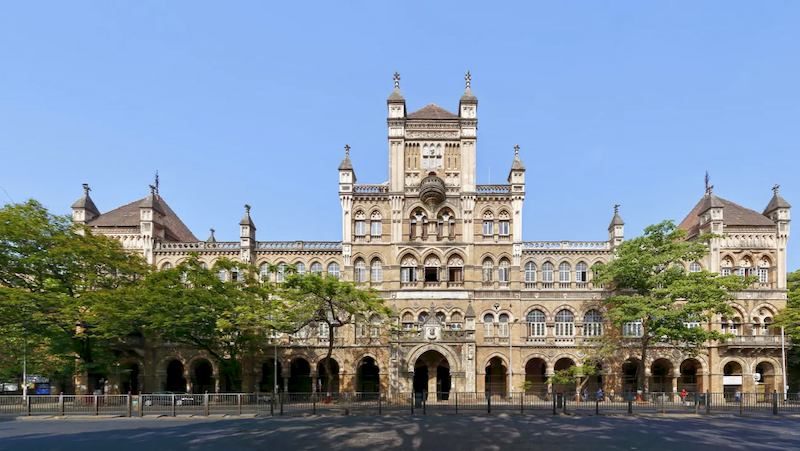
Elphinstone College, modern day
He was a bridge, and history doesn't make statues of bridges
Indian history remembers the people who fought the British. Nana worked with them — and that is exactly why he faded.
He was not a collaborator. He was something harder to be: a man who decided that since he could not remove the people in power, he would extract from them everything he could for his own.
The right for Indians to be Justices of the Peace — six years of lobbying until 1834. The right for Indians to sit on a Grand Jury. The first Indian seat in the Bombay Legislative Council. A university. A railway. Girls' schools.
And when he needed to fight, he fought. The British tried twice to shut down the Sonapur cremation ground in Girgaon. Nana beat them both times — once by leading two thousand Koli fishermen to the Governor's bungalow to explain, in person, what it would mean. When famine came in 1856, he walked five thousand starving people to Government House at Parel.
“Changing a system from inside it, without the clarity of being able to burn it down — most of us will only ever get to be that kind of brave.”
He kept making room for people who weren't his own
Nana was a devout Hindu who built temples and never pretended otherwise. He was also, consistently and at real personal cost, the man who showed up for everyone else.
In 1851, a printing accident made a picture of the Prophet appear to show him blind. Bombay went up. Nana walked the neighbourhoods himself trying to hold the peace — and held the Hindus back from joining in. Had he not, the riot would likely have consumed the whole city.
He opened a school for Koli fishermen's children at his own expense. He fought in the education board for the education of the lowest castes and was called an enemy by his own community for it. At Pandharpur he pushed to open the Vitthal temple to non-Brahmins, decades before Sane Guruji fasted for the same thing. Jyotiba Phule wrote to him and praised him by name.
And in 1842, a twelve-year-old boy, Shripat Sheshadri, was taken in by missionaries. Nana went to the Supreme Court and got him back — and then insisted the boy be received back into his own religion, when the orthodox position was that he was as good as dead. Pune's Brahmins met and fined everyone involved. Nana paid, and never apologised.
He was twenty years old in 1823 when he put his signature next to Raja Ram Mohan Roy's on the petition to end sati.
He gave away the one thing he was best at
He was a moneylender's son and a formidable businessman — the family firm held sixteen lakh rupees in cash by 1800, and Arab and Afghan traders left their treasure with him rather than with banks.
He spent it on other people's children. When he died, his son Vinayakrao sent thirty thousand rupees to the University of Mumbai to fund a Sanskrit scholarship in his father's name. It has been awarded almost every year since 1866. Recipients over the decades have included C.D. Deshmukh — the first Indian to govern the Reserve Bank — Senapati Bapat, R.G. Bhandarkar, and Waman Shivram Apte, whose dictionary students still use.
A hundred and sixty years of teenagers, most of whom never knew whose money it was.
Why he was forgotten — and why that's the point
He left no dynasty; his only grandson died young. He founded no movement with his name on it. He worked with the British in a century that came to define heroism as fighting them. His name is spelled at least eight different ways, so that even someone looking for him has trouble finding him.
He built the machinery that other people became famous using. Dadabhai Naoroji, Ranade, Bhandarkar, Tilak, Gokhale — all of them graduated through Elphinstone College. Nana raised the fund that built it. The Bombay Association he founded in 1852 became the Bombay Presidency Association, which became the Indian National Congress.
He is upstream of people we all remember.
Not nostalgia. Three things, I think.
That the useful life is mostly unglamorous — his greatest achievements are a drainage system, a set of committee minutes, and a fund. He attended meetings for forty-five years.
That you can be devout and generous at once — a man who spent his life making room for others, without ever giving up his own.
That institutions are how you love a place. He could have built a palace. He built a university, and then argued about its curriculum for eight years.
Jagannath “Nana” Shankarsheth, 10 February 1803 – 31 July 1865. His statue stands in the Town Hall at Horniman Circle. His bust is on the front of CSMT, and at the gate of the Sonapur cremation ground, on land he gave the city. Nana Chowk is named after him. So is the road. Most people who use them don't know why.