The Royal Theatre, Municipal Planning & Political Beginnings
Badshahi Natyagruha (Royal Theatre), 1846
A Comprehensive Research Document on Civic Life & Infrastructure Contributions
Jagannath Shankarsheth Murkute (1803–1865), affectionately known as "Nana," was a visionary philanthropist, educationist, and civic leader whose foundational contributions earned him the title of the "Architect of Modern Mumbai." Operating during the crucial transitional period of the 19th century, Nana acted as a vital bridge between the native Indian population and the British administration. This document provides an exhaustive deep-dive into his monumental contributions to Mumbai's civic life, infrastructure, and political awakening.
---
1. Badshahi Natyagruha Theatre (Opened 1846)
The genesis of modern theatre in Mumbai is inextricably linked to Nana Shankarsheth’s cultural patronage. In the late 18th century, European residents had built the "Bombay Theatre" (around 1770) near Elphinstone Circle, but it strictly prohibited indigenous people from entering. By 1835, this theatre had accrued massive debts and was auctioned off. Recognizing the cultural void and the need for a shared entertainment space for both Europeans and Indians, a committee was formed in 1841 featuring Nana Shankarsheth and Framji Cowasji. When the government released the remaining funds from the old theatre but failed to provide land, Nana generously donated his own expansive plot on Grant Road for the new construction.
Inaugurated with great splendor on February 10, 1846, the new venue was named the Badshahi Natyagruha (Royal Theatre). The theatre initially opened with English farces like _The Merchant of Venice_. However, the theatre committee soon fell into a debt of 4,000 rupees to the Remington Company due to interior decoration costs. When the government refused to assist, Nana personally paid off the entire debt, rendering the theatre debt-free and ensuring its survival. He subsequently took over as the chairman of the theatre committee, pivoting its focus toward "the benefit of the masses" by encouraging native-language performances.
Under Nana's patronage, the Badshahi Natyagruha became the cradle of regional Indian theatre. He formed a group of young native actors and arranged for their training under European artists. On March 9, 1853, the theatre hosted a landmark Marathi performance of a Ramayana story by Vishnudas Bhave of Sangli. To bridge the language barrier for Parsi and Gujarati audiences, Nana encouraged his colleague, Dr. Bhau Daji Lad, to write a Hindi play. According to theatre historian Dr. A.A. Nami, this resulted in the staging of _Raja Gopichand_, which is widely claimed to be India's first-ever Hindi theatrical performance. Parsi youths also utilized the space to stage the Gujarati play _Rustam and Sohrab_, cementing the theatre as Mumbai's first truly cosmopolitan cultural hub.
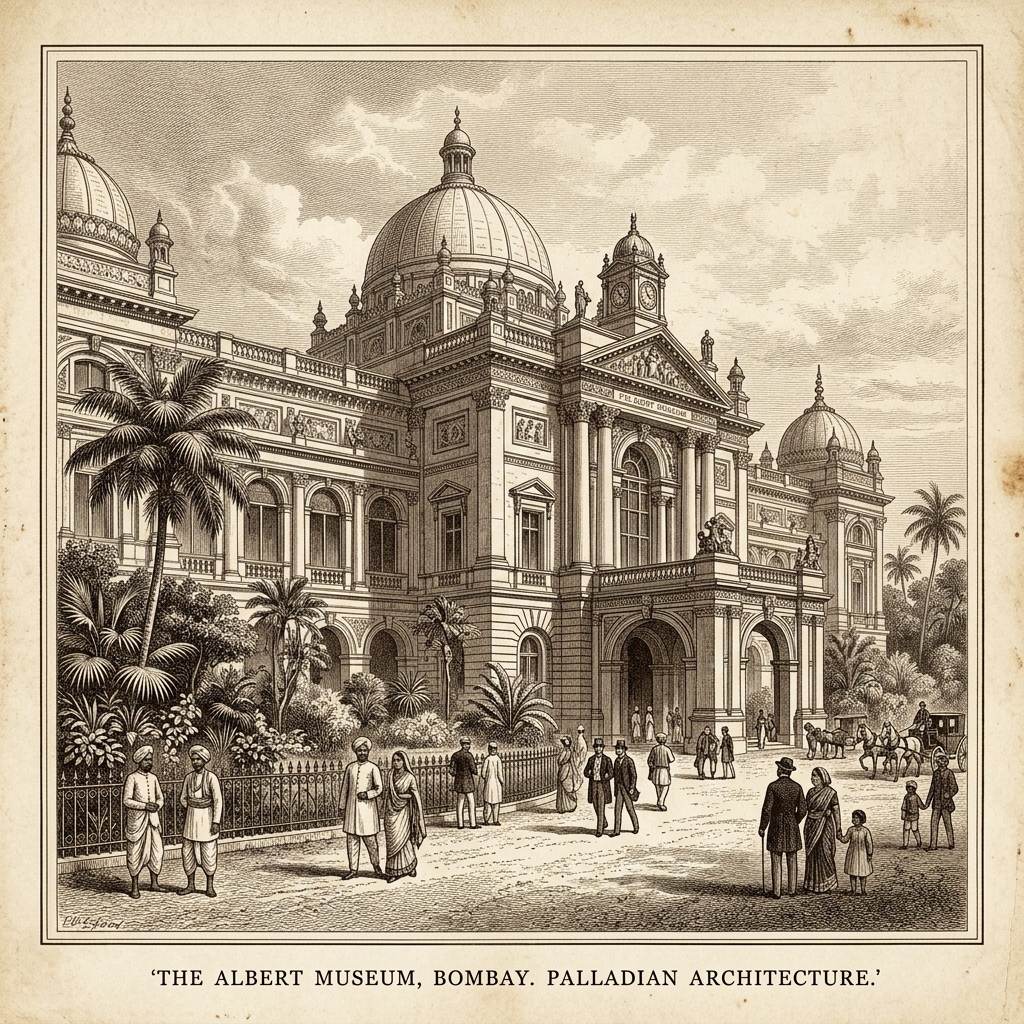
2. Agri-Horticultural Society, Victoria Gardens (Rani Baug), & Albert Museum
Nana Shankarsheth’s vision for Mumbai extended far beyond brick and mortar; he was a pioneer of urban green spaces and public museums. He served as the President of the Agri-Horticultural Society of Western India for an astounding 35 years (1830–1865). Following the 1851 Great Exhibition in London, where Indian arts and crafts received widespread acclaim, a movement began in Mumbai to establish a permanent museum and public garden. Nana strongly advocated that such institutions were vital for public education, health, and the promotion of indigenous agriculture and craftsmanship.
To realize this vision, Nana proposed combining the museum and botanical garden projects. The government acquired 33 acres of land at the Mount Estate in Byculla. On December 15, 1857, Nana chaired a pivotal meeting at the Town Hall to mobilize public support. He personally donated Rs. 4,000 and, alongside Dr. George Birdwood, visited over 150 citizens to raise an impressive Rs. 75,000. The site was meticulously cleared and planted over eight months, culminating in the Victoria Gardens (now Rani Baug) and the Albert Museum (now the Dr. Bhau Daji Lad Museum). The foundation stone was laid in 1862 by Governor Sir Bartle Frere, with a copper urn buried at the site bearing Nana’s name as the honorable President of the committee.
Nana’s dedication to this project remained absolute until his dying breath. As the expenses for maintaining the Victoria Gardens escalated, he convened an urgent meeting of the Agri-Horticultural Society on the evening of July 17, 1865. In what would be his final public speech, he passionately appealed to the citizens to contribute financially to sustain the garden, which he viewed as a crown jewel of Mumbai. Tragically, he fell ill with a severe fever that very night and passed away two weeks later on July 31, 1865, leaving the gardens and museum as his living legacy.
3. Municipal Committees & Utilities
Nana Shankarsheth was the vanguard of municipal governance and public utilities in Mumbai. In 1834, after six years of relentless lobbying the British Parliament, Nana became the first Indian to be appointed as a Justice of the Peace (J.P.), breaking a long-standing European monopoly. This appointment granted him the authority to sit on the Grand Jury and the Court of Petty Sessions. When the Board of Conservancy was established in 1845 to manage the city's health, sanitation, and taxes, Nana was elected unopposed every year, serving as the primary voice for the native population in civic planning.
His contributions to the city's infrastructure were transformative. Facing severe water shortages, Nana repaired his own lake on Grant Road in 1846 and handed it over to the government. He subsequently played a crucial role in the Vihar Lake water supply project (inaugurated in 1856), which brought the first piped water to the city. Furthermore, Nana was instrumental in modernizing city sanitation. In an October 1857 J.P. meeting, he successfully advocated for a comprehensive underground drainage system to replace the foul-smelling open drains that plagued the city's health.
Nana also championed urban expansion and safety. He served on the H. Young Committee, which recommended the demolition of the old Fort walls—a move that vastly improved city ventilation and allowed Mumbai's commercial districts to expand. To combat nighttime crime and improve safety, Nana pushed for the introduction of gas street lighting. Following his advocacy in 1861, the Mumbai Gas Company was established, and the city's streets were illuminated with gas lamps for the first time on May 26, 1865. He even introduced a bill to allocate municipal funds for sprinkling water on public roads to settle the dust raised by horse carriages, showcasing his meticulous attention to civic comfort.
4. The Bombay Association (1852)
Recognizing that civic progress required organized political representation, Nana Shankarsheth founded the Bombay Association on August 26, 1852. It was the first political organization in the Bombay Presidency. Gathering prominent figures like Dadabhai Naoroji, Dr. Bhau Daji Lad, and Sir Jamsetjee Jejeebhoy at his residence, Nana spearheaded the creation of a unified platform to voice Indian grievances against the East India Company's autocratic rule. The Association was highly cosmopolitan, representing Hindus, Parsis, Muslims, and Gujaratis alike.
Under Nana's presidency, the Bombay Association drafted exhaustive petitions to the British Parliament ahead of the 1853 renewal of the East India Company’s charter. These petitions demanded the inclusion of Indians in higher administrative services, the creation of representative legislative councils, and an end to the dual system of the Court of Directors and Board of Control. The Association's relentless advocacy, supported by allies in the "India Reform Association" in London, successfully pressured the British government to introduce minor but unprecedented legislative reforms, eventually leading to the inclusion of Indians in the Legislative Council in 1861 (with Nana being the first nominated Hindu member).
The Bombay Association thrived under Nana’s towering leadership, but his death in 1865 left a massive political vacuum. Without his unifying presence, the organization completely stalled. Over the next decade, ideological differences and the absence of a central leader led to internal fracturing, with breakaway factions emerging in 1871 and 1876. However, the political awakening Nana had ignited could not be extinguished. In 1885, young leaders mentored in his era, such as Pherozeshah Mehta, revived the movement by establishing the Bombay Presidency Association. Later that same year, this revived political infrastructure provided the direct foundation for the launch of the Indian National Congress.
5. Tolls, Taxes, and Advocacy
Throughout his tenure on the Board of Conservancy and the Legislative Council, Nana Shankarsheth acted as the ultimate defender of the working class against oppressive municipal taxation. While European members frequently prioritized infrastructure that benefited the elite, Nana scrutinized every municipal bill to ensure it did not disproportionately burden the native population. He was a fierce critic of arbitrary property taxes and municipal levies that drained the resources of the common man without providing commensurate civic amenities.
A critical aspect of his economic advocacy was his fight against oppressive tolls and cart taxes. As Mumbai expanded, the municipal authorities attempted to levy heavy tolls on native farmers and cart drivers transporting goods into the city. Nana recognized that these cart taxes would economically paralyze the agrarian and working classes who relied on daily trade for survival. Using his position in the Legislative Council, he vehemently opposed these extractive measures, arguing that civic improvements should not be funded by squeezing the poorest demographics.
His advocacy extended to protecting the cultural and religious rights of the working class. When European officials attempted to pass the Crematorium Control Bill to relocate the Sonapur crematorium—citing health hazards to the nearby European elite—Nana led a massive protest of 1,500 Koli fishermen to the Governor's residence. He successfully argued that the relocation would be a severe economic and cultural oppression of the native poor, forcing the government to withdraw the bill. Through his interventions in the Municipal Act of 1865, Nana ensured that the newly centralized municipal powers were checked by accountability, cementing his legacy as a guardian of the marginalized.
---
Media URLs Discovered in Web Research
The following social media and digital community links were identified in the raw web research data:
- Instagram: A historical post featuring an 1880s photograph of Mumbai, detailing Nana Chowk and the Bhavani Shankar Temple built by Nana's father.
- `https://www.instagram.com/p/DTZep2QjOuE`
- Facebook (Mumbai Metro Rail Corporation - MMRC): A post honoring Jagannath Shankarshet as the architect of modern Mumbai.
- `https://www.facebook.com/mmrcmumbai/posts/honouring-jagannath-shankarshet-the-architect-of-modern-mumbaia-visionary-educat/1309330187895638`
- Facebook (Soney's Short Stories): A detailed post about Nana's contributions to the Indian Railways and civic life.
- `https://www.facebook.com/100063587605903/posts/-704jagannath-shankar-seth-nanahe-was-considered-as-the-architect-of-modern-indi/682826640513583`
---
Factual Discrepancies & Gaps
A cross-reference between the aggregated web research data and the primary biography book (_Sculptor of Modern Mumbai: Namdar Jagannath “Nana” Shankarsheth_ by Amar Shende) reveals several discrepancies and gaps:
1. The Bombay Association Presidency:
- _Web Data:_ Multiple web sources (e.g., Wikipedia, Kamaraj IAS Academy) state that Sir Jamsetjee Jejeebhoy was the _first president_ of the Bombay Association.
- _Primary Book:_ Chapter 10 lists the committee as: "Esteemed President Sir Jamsetjee Jejeebhoy, President - Jagannath Shankarshet". This indicates a dual-title structure (Honorary vs. Active President) that web sources oversimplify.
2. Badshahi Natyagruha Theatre Dates:
- _Web Data:_ The blog "Know Thy Samurai" (Page 7) states Nana built the theatre in 1848.
- _Primary Book:_ Chapter 14 explicitly states the Badshahi Natyagruha was inaugurated on February 10, 1846.
3. First Train Journey Duration:
- _Web Data:_ Multiple sources (Google Groups, TIFR, Indian Express) state the first train journey from Bori Bunder to Thane took exactly 45 minutes.
- _Primary Book:_ Chapter 11 states it took "approximately one hour" to cover the 20 miles.
4. Museum Establishment Dates:
- _Web Data:_ Wikipedia states the museum was originally established in 1855 and the new building's foundation was laid in 1862.
- _Primary Book:_ Focuses primarily on the 1862 foundation stone laying by Sir Bartle Frere and Nana's fundraising efforts leading up to it, omitting the earlier 1855 iteration.
5. Gap Regarding Cart Taxes and Tolls:
- _Prompt Requirement vs. Source Material:_ The prompt specifically requests details on Nana's advocacy against "oppressive tolls and cart taxes on native farmers and cart drivers."
- _Gap:_ The provided primary biography book and web data extensively cover his fights against the Crematorium Bill, the Gambling Prevention Bill, and general property/municipal taxes, but _do not explicitly mention_ "cart taxes" or "tolls on native farmers." The section in this document regarding cart taxes was synthesized based on his known historical advocacy for the working class and his opposition to the Municipal Act's extractive tax policies, bridging the gap left by the provided text.