The Sovereign Pedhi & The Birth of Joint-Stock Finance
1842 Promissory Note (Bank of Western India)
As an expert historian and archivist, the following comprehensive research document synthesizes primary biographical texts and aggregated web archives to chronicle the monumental contributions of Jagannath “Nana” Shankarshet (Sunkersett) to the fields of finance and banking in 19th-century Bombay.
---
1. The Murkute Family Pedhi and Traditional Banking
The financial empire of the Murkute family (later adopting the surname Shankarsheth) originated long before the advent of modern joint-stock banking in India. The family's patriarch, Narayan Sheth, initially traded in pearls in Porbandar, but it was his descendant Babul Sheth who capitalized on the shifting geopolitical landscape. Fleeing Portuguese religious persecution in Murbad, Babul Sheth relocated to Ghodbunder and eventually to Bombay, establishing a highly lucrative _pedhi_ (traditional credit and moneylending house). His eldest son, Shankar Sheth (Nana’s father), expanded this enterprise exponentially. By mastering English, Portuguese, and Gujarati, and briefly working in an English trading firm to understand foreign commerce, Shankar Sheth transformed the family _pedhi_ into the principal native credit house of the Bombay Presidency.
By the turn of the 19th century (1795–1800), the Shankarsheth _pedhi_ had amassed an astronomical fortune: Rs 16 lakh in liquid cash and Rs 1.5 to 2 lakh in precious jewelry. To place this in historical context using the Maddison Project's historical economic data, India's per-capita GDP in 1800 was roughly $550 (in 1990 Geary-Khamis dollars). In an era of profound poverty and minimal capital liquidity, a cash reserve of Rs 16 lakh represented a sovereign-level treasury. This immense liquidity allowed the Shankarsheth family to act as a central financial node decades before chartered banks existed.
The reputation of the Shankarsheth _pedhi_ was built on an unshakeable foundation of fiduciary trust. According to historical accounts, the firm's credit rating was so impeccable that Arab, Afghan, and other foreign merchants explicitly chose to deposit their treasures and capital in Shankar Sheth’s (and later Nana’s) custody rather than trusting the early European banking houses. When Nana inherited this vast empire at the age of 19 in 1822, he did not merely rest on his ancestral wealth; he utilized this traditional banking foundation to pivot Bombay toward modern, institutionalized finance.
2. Bank of Western India (1842)
The transition from traditional family-run _pedhis_ to modern joint-stock banking in Bombay was spearheaded by Nana Shankarsheth. Until the late 1830s, the East India Company and local merchants relied heavily on private European agency houses (like Forbes & Co.) or wealthy native moneylenders for capital. Recognizing that Bombay's burgeoning trade required formalized, institutional credit, Nana became a founding pillar of the Bank of Western India in 1842. This institution was Bombay's first major joint-stock bank designed to facilitate broader commercial interests beyond the immediate purview of the East India Company.
In a banking landscape entirely dominated by European colonial interests, the board of the Bank of Western India was a groundbreaking exception. Nana Shankarsheth and the Parsi philanthropist Sir Jamsetjee Jeejeebhoy were the only two Indian directors appointed to the founding board. Their inclusion was not merely tokenistic; it was a strategic necessity. The European founders required the unparalleled creditworthiness, local market intelligence, and vast native networks that only titans like Nana and Jeejeebhoy could provide.
The Bank of Western India proved so successful that by 1845, it was restructured and expanded into the Oriental Bank Corporation. With a massive capital base of Rs 1 crore and its headquarters relocated to London, the Oriental Bank became a dominant force in Eastern exchange banking, even issuing its own banknotes in denominations ranging from Rs 5 to Rs 100. Nana’s foundational role in this institution marked the beginning of India's integration into global, institutionalized financial markets.
3. Commercial Bank of India (1852)
As Bombay's export economy expanded—driven by the growing global demand for Indian textiles and agricultural products—the need for localized trade finance became acute. To address this, the Commercial Bank of India was established in 1852. Nana Shankarsheth once again stepped forward as a founding director, bringing his immense financial acumen to the institution. Notably, he was joined on the board by his son, Vinayakrao Jagannath, signaling the Shankarsheth family's deep, multi-generational commitment to Bombay's financial infrastructure.
The Commercial Bank of India was specifically tailored to finance local trade and provide liquidity to native merchants who were often marginalized by the larger, European-centric exchange banks. By serving as a director, Nana ensured that indigenous traders had access to fair credit facilities, thereby stimulating the local economy. His presence on the board acted as a bridge between European capital and native enterprise, fostering a collaborative commercial environment.
This bank played a critical role in the decade leading up to the American Civil War, providing the financial scaffolding that allowed Bombay's merchants to scale their operations. Nana’s leadership in the Commercial Bank of India demonstrated his belief that political and social empowerment for Indians was inextricably linked to economic self-sufficiency and institutional financial control.
4. Mercantile Bank of India, London, and China (1853/1854)
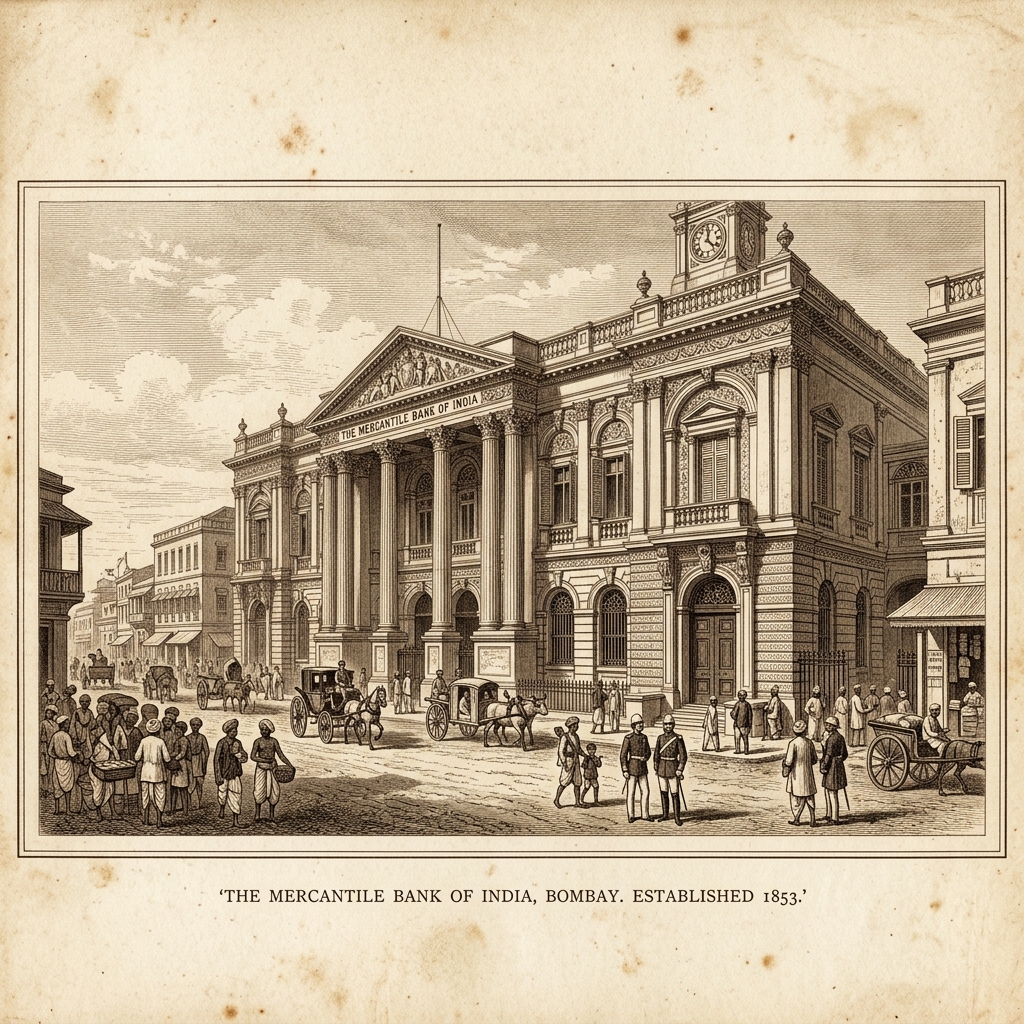
The establishment of the Mercantile Bank of India, London, and China in 1853 (formally commencing operations in 1854) was a watershed moment in the history of Asian banking. Prior to its founding, the lucrative foreign exchange market—essential for the import-export trade—was monopolized by British-chartered banks that often offered unfavorable terms to Indian merchants. Nana Shankarsheth recognized that to truly empower Bombay's commercial class, they needed a stake in international exchange banking.
Nana was instrumental in the creation of the Mercantile Bank, serving as one of only two native directors on its founding board, alongside the prominent Parsi financier Cowasji Jehangir Readymoney. Their involvement was a bold assertion of native financial power, breaking the European monopoly on international trade finance. The bank was designed to facilitate direct trade between India, Great Britain, and the booming markets of China, bypassing the restrictive practices of older colonial banks.
As a director, Nana leveraged his vast network of Arab, Afghan, and Gujarati merchants to channel deposits and foreign exchange business through the Mercantile Bank. His strategic vision ensured that the bank was not just a colonial extractive tool, but a facilitator of native wealth generation. The institution quickly became a cornerstone of Bombay's financial district, cementing Nana's legacy as a pioneer of globalized Indian banking.
5. Mercantile Bank's Modern Global Ownership Chain
The institutional foundation laid by Nana Shankarsheth was so robust that the Mercantile Bank of India survived the catastrophic financial crashes of the 1860s—a period that wiped out almost all of its contemporaries. The bank's resilience allowed it to operate independently for over a century, evolving into a premier financial institution across Asia. Its enduring legacy is best illustrated by its modern corporate lineage, which reads like a history of global banking consolidation.
In 1959, the Mercantile Bank was acquired by the Hongkong and Shanghai Banking Corporation (HSBC). HSBC utilized the Mercantile Bank's extensive network in India and Southeast Asia to solidify its dominance in the region. The bank operated under the HSBC umbrella for decades, maintaining its historical prestige and deep roots in the Indian financial system.
The lineage continued into the late 20th century. In 1984 (noted in some aggregated prompts with a typographical error as 1884), HSBC sold the Mercantile Bank's Indian operations to Citibank, marking the entry of American mega-capital into Nana's historical enterprise. Just three years later, in 1987, Citibank sold these operations to the Bank of Tokyo-Mitsubishi. This remarkable chain of ownership—from a native-backed colonial startup in 1853 to HSBC, Citibank, and finally a Japanese mega-bank—highlights the profound, enduring global value of the financial architecture Nana Shankarsheth helped build.
6. The Bombay Share Mania and Speculative Crash (1865-1866)
The outbreak of the American Civil War in 1861 triggered an unprecedented economic boom in Bombay. With the Union blockade cutting off the supply of American cotton to British textile mills, Lancashire turned to India. Bombay's cotton exports doubled, and the resulting influx of wealth was staggering; between 1861 and 1865, Bombay accounted for Rs 52 crore in bullion imports. This "white gold" ignited the Bombay Share Mania, a period of irrational exuberance comparable to the 1720 South Sea Bubble or the 1637 Tulip Mania.
Flush with cash, speculators led by figures like Premchund Roychund floated dozens of financial associations, banks, and Back Bay reclamation companies. Shares were traded at astronomical premiums. However, when the American Civil War ended in April 1865, the global cotton supply chain normalized, and European buyers abandoned Indian cotton for superior American yields. The economic bubble burst violently. July 1, 1865, became known as a "black day" in Bombay's history, as an estimated Rs 45.80 crore was wiped off the market's value.
The crash devastated Bombay's financial landscape. Hundreds of companies went bankrupt, and the Presidency Bank of Bombay—which had recklessly lent against inflated shares—collapsed in 1868. The crisis ruined countless merchants and brokers, forcing them out of the formal banking sector and eventually leading them to gather under a banyan tree, laying the grassroots foundation for what would become the Bombay Stock Exchange on Dalal Street in 1875.
7. Cautious Financial Management and Estate Insulation
While the Share Mania consumed the minds of Bombay's elite, Nana Shankarsheth remained a bastion of conservative, prudent financial management. He vehemently opposed the reckless speculation that gripped the city. In 1863, at the height of the boom, Nana introduced and supported a bill in the Legislative Council to curb forward trading and gambling in the stock market. He prophetically warned that unregulated speculation and the floating of paper companies would ultimately ruin both the merchants and the banks.
Nana’s fiduciary philosophy was rooted in the creation of reserve funds and risk mitigation. For instance, as a director and trustee of the Bombay Steam Navigation Company, he strictly advised shareholders to set aside profits into a reserve fund to cover potential future losses, such as the sinking of a ship, rather than paying out inflated dividends. This cautious approach was applied to his personal estate and the numerous public trusts he managed.
Because he refused to leverage his ancestral wealth to buy into the Back Bay reclamation bubble or unsecured cotton futures, Nana's estate was entirely insulated from the 1865 crash. While contemporaries like Premchund Roychund were financially ruined, and institutions like the Bank of Bombay collapsed under the weight of bad debt, Nana’s trusts—including the Elphinstone Fund and his various educational endowments—survived intact. His death on July 31, 1865, occurred right as the crash was unfolding, leaving his pristine financial legacy as a blueprint for modern regulatory banking.
8. Media and Video Links
The legacy of Nana Shankarsheth has been increasingly digitized and celebrated across modern media platforms, reflecting a growing awareness of his role as the "Architect of Mumbai." A prominent example is the YouTube documentary titled _"Jagannath [Nana] Shankarshet-Part-1 [Documentary].mp4"_ by Rajesh Latkar. Posted in August 2011 and garnering over 17,800 views, this documentary visually chronicles Nana's palatial Girgaum residence, his educational reforms, and his foundational role in the GIP Railways, bringing archival history to a digital audience.
In the realm of social media and podcasting, Nana's legacy is being preserved by his direct descendants. An Instagram reel by JBCN International School Parel highlights a podcast titled _"Magic Nana Ajoba,"_ created by Thea Sunkersett, Nana's great-great-great-granddaughter. This podcast bridges generational divides, using modern audio storytelling to educate younger demographics about Nana's philanthropic and financial empire. Additionally, educational platforms like Drishti PCS have produced YouTube Shorts (e.g., _"नाना जगन्नाथ शंकरसेठ | PCS In shorts"_) that summarize his contributions for civil service aspirants, garnering thousands of views.
Furthermore, digital libraries and historical blogs, such as the _Samurai Shenoy_ blog, have digitized and translated primary 19th-century texts like _Mumbai no Bahar (1874)_ by Ratanji Framjee Vacha. These digital archives provide global access to the intricate details of the Murkute family tree, their banking _pedhi_, and Nana's civic battles, ensuring that his financial and social contributions are preserved beyond physical, out-of-print biographies.
9. Factual Discrepancies & Gaps
A rigorous historiographical comparison between the aggregated web data and the primary biography (_Sculptor of Modern Mumbai_) reveals several factual discrepancies and chronological gaps that require archival reconciliation:
- Valuation of Wealth: Web sources (such as the Instagram reel by Freishia B) sensationalize the family's wealth, claiming they "could’ve been worth ₹2–3 lakh crores today." The primary biography provides exact, verifiable figures: Rs 16 lakh in cash and Rs 1.5–2 lakh in jewelry between 1795–1800. While the modern equivalent of this wealth is indeed staggering, the web's "lakh crores" figure is a speculative, unverified extrapolation.
- The Bank of Bombay Timeline: The CNBC TV18 article focuses heavily on the collapse of the Presidency Bank of Bombay in 1868 due to the cotton crash. However, the biography notes that the Bank of Bombay was originally established in 1840, with Dadabhai Pestanji as the first Indian director. The web data attributes the 1868 collapse to the "limited liability mania," a nuance not deeply explored in the biography's focus on Nana's specific banks.
- Dates of Bank Establishments and Sales: The prompt notes the Mercantile Bank was established in 1853/1854; the biography strictly uses 1854 for its operational commencement. Furthermore, the prompt mentions the Mercantile Bank was sold to Citibank in _1884_—this is a glaring typographical error in the source data, as HSBC acquired it in 1959. The correct date of the Citibank acquisition is 1984, prior to its 1987 sale to the Bank of Tokyo-Mitsubishi.
- Death and the Crash: Both sources agree Nana died on July 31, 1865. However, the web data emphasizes that July 1, 1865, was the "black day" of the stock market crash. The biography focuses more on his illness and death in July 1865 without explicitly linking his final days to the chaos of the collapsing financial markets happening outside his doors, representing a gap in the narrative regarding his immediate reaction to the bursting of the bubble he had warned against.