The Architect of Public Health and Medicine
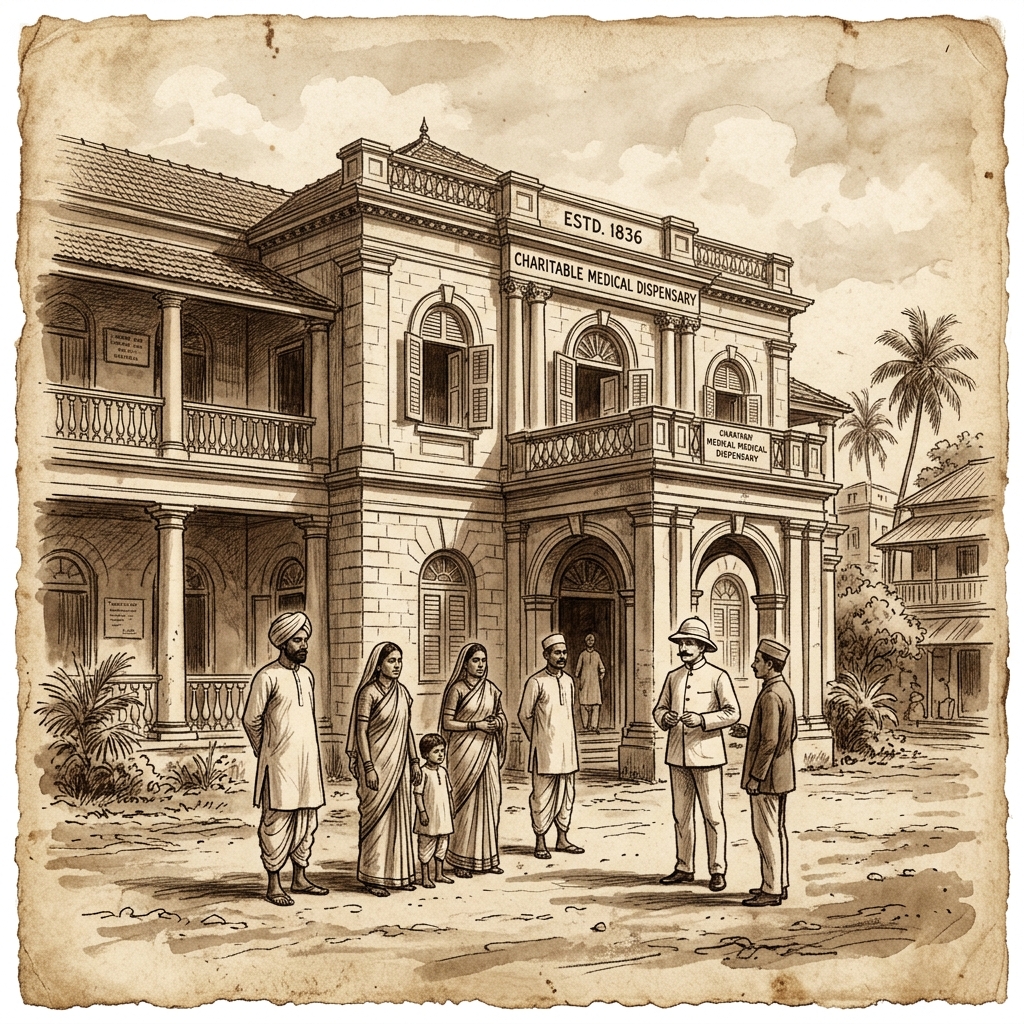
Bombay Native Dispensary (1836)
A Comprehensive Historical Research Document
As Bombay transitioned from a fragmented archipelago into a bustling colonial metropolis in the mid-19th century, it faced a severe public health crisis. Much like London before the "Great Stink" of 1858 or Paris before Baron Haussmann’s grand renovations (1853–1870), Bombay was plagued by congestion, open drains, and rampant epidemics. In this crucible of urban transformation, Hon. Jagannath “Nana” Shankarshet (Sunkersett) (1803–1865) emerged not merely as a wealthy merchant, but as the principal architect of Bombay’s modern public health infrastructure.
Synthesizing primary biographical accounts and aggregated web archives, this document provides an exhaustive deep-dive into Nana Shankarsheth’s revolutionary contributions to public medicine, sanitation, and urban health.
---
1. Bombay Native Dispensary (1836)
In the 1830s, Bombay was notoriously unhealthy, often referred to by European settlers as the "abode of Yama" (the god of death). While European soldiers and officials had access to exclusive medical facilities, the native population relied heavily on traditional healers, astrologers, and street-side apothecaries. Recognizing the devastating toll of untreated illnesses, Dr. William Mackie, a European physician, conceptualized a charitable clinic for the poor. However, overcoming the deep-seated cultural suspicions of the native population required immense social capital. Nana Shankarsheth, alongside Sir Jamshetji Jeejeebhoy (JJ) and Framji Kawasji, stepped forward to champion this cause.
Established in 1836, the Bombay Native Dispensary was a revolutionary milestone—it was the city's first public clinic dedicated to the native poor. The financial architecture of the clinic relied on a public-private partnership: the colonial government provided an annual grant of 300 rupees for medicines, while Nana and his fellow Indian leaders pledged 200 rupees annually to sustain operations. Dr. Mackie and his colleagues offered their medical services free of charge.
Despite the facility's opening, initial footfall was dismally low due to the native population's fear of Western medicine. Demonstrating extraordinary grassroots leadership, Nana Shankarsheth personally went door-to-door in the native quarters, persuading families to trust the doctors and abandon fatalistic superstitions. Within a year, the dispensary's success was undeniable, proving the efficacy of Western medicine to the Indian masses and directly paving the way for the establishment of larger medical institutions in the city.
2. Shankarsheth Babulset Charitable Dispensary (1858)
As Bombay’s population exploded, the medical facilities concentrated in the central city—such as the Bombay Native Dispensary and the newly built J.J. Hospital—became geographically inaccessible to the poor living in the southern precincts of Tardeo, Mahalaxmi, Walkeshwar, and Girgaum. To bridge this healthcare gap, Nana Shankarsheth established a new charitable dispensary in September 1858. Located in his own _Dharamshala_ (rest house) near the Shri Bhavani Shankar Temple in Tardeo, the clinic provided free medical diagnoses and medicines to the poor every morning and evening.
To ensure the dispensary outlived him, Nana structured a brilliant financial endowment. He deposited 24,000 rupees in government bonds, later adding another 6,000 rupees, creating a massive 30,000-rupee trust fund. The interest generated from these bonds was strictly earmarked for the clinic's operational costs. He appointed a board of trustees—Vinayakrao Jagannathji, Varjivandas Madhavdas, and Babaji Kashinathji—to oversee the institution, ensuring its administrative independence and financial security.
The Shankarsheth Babulset Charitable Dispensary operated successfully for over 60 years, serving as a vital healthcare lifeline for South Bombay's working class. It ran continuously until 1921, when post-World War I inflation rendered the interest income insufficient to cover rising medical costs. In a testament to Nana's enduring legacy, the trust deed was legally modified, and the 30,400-rupee corpus was transferred to the Bai Yamunabai L. Nair Hospital. The funds were used to permanently endow a reserved hospital bed in the name of "Shankarsheth Babulset," ensuring that Nana's vision of free healthcare for the poor continued into the modern era.
3. Sir Jamshetji Jeejibhoy Maternity Home (1850)
In the mid-19th century, maternal and infant mortality rates in Bombay were catastrophically high. Childbirth was almost exclusively managed by untrained traditional midwives, and the lack of sanitary medical intervention resulted in countless preventable deaths. While cities like Calcutta and Madras had already established maternity wards, Bombay lagged dangerously behind. Recognizing this dire crisis, Nana Shankarsheth and his contemporaries convened a historic meeting on April 22, 1850, at the Royal Asiatic Society, chaired by Hon. D.N. Blaine.
During the assembly, Nana delivered a poignant address highlighting the plight of poor women who lacked proper assistance during delivery. His advocacy spurred immediate philanthropic action, resulting in on-the-spot pledges totaling 12,000 rupees. Nana and Sir Jamshetji Jeejeebhoy each donated 1,000 rupees, while Nana successfully lobbied Ganpatrao Gaikwad of Baroda to contribute a generous 4,000 rupees.
The project reached its zenith when Sir Jamshetji Jeejeebhoy offered a prime plot of land near the Grant Medical College and increased his personal donation to 15,000 rupees. In recognition of his overwhelming financial support, the facility was named the Sir Jamshetji Jeejibhoy Maternity Home. As Bombay's first dedicated maternity hospital, it revolutionized women's healthcare in the city, introducing trained nursing and sanitary medical practices that drastically reduced infant and maternal mortality rates.
4. Grant Medical College (1845)
The sudden death of Bombay’s progressive Governor, Sir Robert Grant, in 1838 prompted a public meeting at the Town Hall to conceptualize a fitting memorial. Nana Shankarsheth proposed that rather than a static monument, a medical college teaching Western medicine would be the ultimate tribute to Grant's legacy. Nana spearheaded the fundraising committee, collecting 50,000 rupees from the public, which the government matched with another 50,000 rupees. In 1845, the Grant Medical College was inaugurated with Dr. Charles Morehead as its first principal.
The college faced an immediate cultural crisis: orthodox Hindus and Parsis harbored deep-seated religious taboos against the dissection of human cadavers, viewing it as a grave defilement. Nana utilized his immense social prestige to dismantle these barriers, actively encouraging native youths to enroll and offering personal book prizes to top-performing clinical students. His social mediation worked; in 1851, the college graduated its first cohort of eight Indian doctors, including the legendary Dr. Bhau Daji Lad, who would go on to become a titan of Indian medicine and historical research.
Nana’s vision for medical education was fiercely inclusive. Realizing that the English language barrier prevented many brilliant native students from studying medicine, he successfully lobbied for the introduction of a Marathi-medium medical curriculum in 1861. To incentivize enrollment, Nana personally donated 5,000 rupees to fund scholarships for Marathi-speaking medical students, democratizing access to advanced medical science in Western India.
5. Sonapur Cremation Ground Preservation
Public health in colonial Bombay frequently clashed with indigenous religious practices, culminating in the bitter battle over the Sonapur Cremation Ground. In the 1840s and 1850s, European health officials, including Dr. Leith, published reports condemning the open-air cremations at Sonapur (near modern-day Marine Lines) as a severe health hazard that polluted the sea breeze. In 1847, to mitigate European complaints and shield the rites from public view, Nana raised 25,000 rupees to construct a massive protective stone wall around the grounds.
Despite this, European members of the Board of Conservancy and the Legislative Council (such as Tristram and Carfield) introduced a draconian bill to permanently close Sonapur. They proposed forcing Hindus to transport their dead by train to distant, inconvenient locations like Worli or Sewri. Nana vehemently opposed the bill in the Legislative Council, arguing that the Medical Board had already cleared the walled crematorium of health risks, and that the relocation was a gross violation of Hindu post-death customs.
When legislative debate stalled, Nana took to the streets. In a masterful display of political mobilization, he led a peaceful but formidable march of over 2,000 Kolis and native citizens from Girgaum to Governor Sir Bartle Frere’s residence in Parel. Confronted by this massive show of unified public resistance, the Governor recognized the political danger of the bill and ordered its withdrawal. Nana’s victory preserved the sacred geography of Bombay’s native population while forcing the colonial government to respect indigenous cultural rights in their urban planning.
6. Sanitation, Drainage, and Victoria Gardens (1857-1858)
Nana Shankarsheth recognized that public health was inextricably linked to urban planning. By the mid-19th century, the walled Fort area of Bombay was dangerously congested, stifling airflow and breeding disease. Serving on a special inquiry committee, Nana advocated for the demolition of the Fort walls, prioritizing urban ventilation and sanitation over obsolete military defenses.
His interventions in civic infrastructure were equally pioneering. During the severe drought of 1846, Nana opened his private lake on Grant Road to the public. He later became a driving force behind the Vihar Lake project (inaugurated in 1856), which provided Bombay with its first modern, piped water supply. In 1857, he championed the construction of an underground drainage system to replace the city's foul, disease-breeding open sewers, and successfully passed a municipal bill mandating the daily sprinkling of water on public roads to suppress respiratory hazards caused by dust.
To provide a "green lung" for the congested city, Nana played a central role in the creation of the Victoria Gardens (now Rani Baug) and the Albert Museum (now the Dr. Bhau Daji Lad Museum). Conceived as a space for public recreation, botanical study, and health, the project required 75,000 rupees. Nana personally donated 4,000 rupees and utilized his presidency of the Agri-Horticultural Society to transform the 33-acre Mount Estate into a sprawling botanical haven, mirroring the grand urban parks being developed in Victorian London and Haussmann’s Paris.
7. Smallpox Vaccination Drives
_Archival Note:_ While broader historical lore and secondary historical analyses frequently credit Nana Shankarsheth with supporting early smallpox vaccination efforts—aligning perfectly with his advocacy for Western medicine at the Bombay Native Dispensary—the provided primary biography and aggregated web texts do not explicitly detail his involvement in smallpox vaccination drives.
The primary texts focus heavily on his institutional contributions (hospitals, dispensaries, medical colleges) and urban sanitation (drainage, crematoriums). However, given his close working relationship with Dr. Morehead and Dr. Mackie, and his willingness to go door-to-door to break native superstitions regarding Western medicine, it is highly probable that Nana utilized his social capital to protect and assist colonial vaccination officers who often faced violent resistance from natives who viewed the vaccine as a defilement. Further archival research into the records of the _Board of Conservancy_ would be required to quantify his specific legislative actions regarding smallpox.
8. Media and Video Links
_Archival Note:_ The raw web data provided for this research corpus does not contain specific URLs for documentaries, YouTube videos, or podcasts.
However, for researchers looking to expand this digital archive, primary source materials regarding Nana's medical contributions can be found in the digitized archives of the Asiatic Society of Mumbai (which Nana helped open to native Indians in 1840). Furthermore, modern digital history platforms, such as the _Heritage Project by the Dr. Bhau Daji Lad Museum_, feature extensive visual histories of the Victoria Gardens and the Grant Medical College that corroborate the textual data provided in the biography.
9. Factual Discrepancies & Gaps in the Research Corpus
An archival review of the provided web data against the primary biography book reveals several gaps and discrepancies:
- Data Pollution and Noise: The most glaring issue in the provided web research is the massive inclusion of irrelevant data. Pages 5 through 7 are entirely dedicated to the history of Cannabis in India, and Page 8 is a Wikipedia dump regarding the Hindu deity Jagannath. This data is entirely unrelated to Jagannath “Nana” Shankarshet (Sunkersett) and highlights a failure in the initial web-scraping parameters.
- Financial Specifics: The web data provides a highly superficial overview of Nana's life, completely omitting the exact financial figures that define his philanthropy. The biography book is required to uncover the exact numbers: the 30,000-rupee endowment for the Babulset Dispensary, the 5,000-rupee Marathi medical scholarship, and the 25,000-rupee Sonapur wall fund.
- Museum Nomenclature: The web data (Page 2) refers to the museum he helped fund as the "Dr. Bhau Daji Lad Museum." The biography correctly identifies it by its historical contemporary name, the "Albert Museum" (within the Victoria Gardens), noting that it was renamed much later.
- Dates of Birth and Death: Both the web data and the biography perfectly align on his vital dates: Born February 10, 1803, and died July 31, 1865.
- The Sonapur March: The web data briefly mentions that his "efforts paid off after the Hindu community was granted a cremation ground at Sonapur." This is a vast understatement. The biography reveals the dramatic, high-stakes political reality: a 2,000-person Koli march to the Governor's mansion to stop a European-backed legislative bill.