The Foundation of Vernacular & Higher Learning
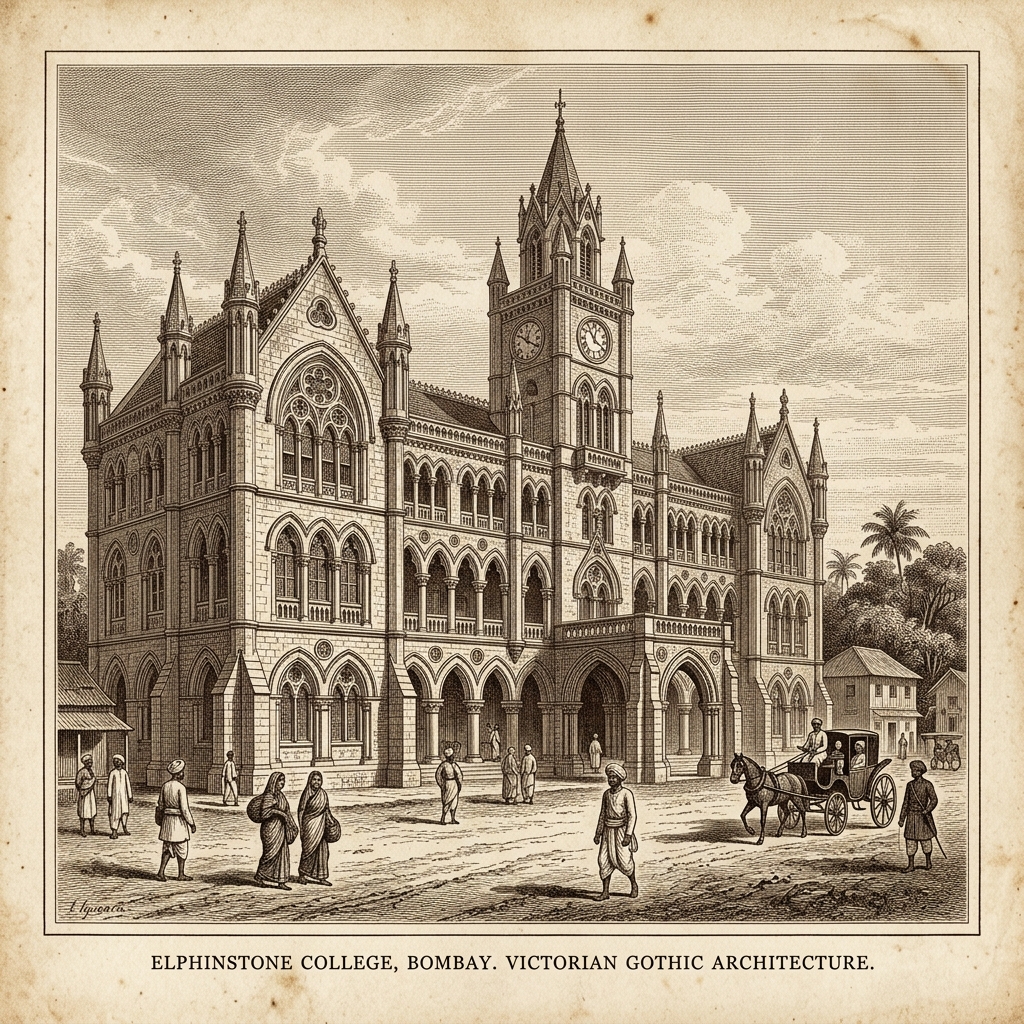
Elphinstone College (1856)
Jagannath “Nana” Shankarshet (Sunkersett) Murkute (1803–1865) was a pioneering philanthropist, social reformer, and the undisputed "Uncrowned King of Bombay." While his contributions to urban infrastructure and the Indian Railways are legendary, his most enduring legacy lies in his revolutionary efforts to democratize education in Western India. Synthesizing archival web data and comprehensive biographical accounts, this document provides an exhaustive deep-dive into his monumental contributions to the educational landscape of Bombay.
---
1. Elphinstone College and Institution (1820s-1830s)
The genesis of the Elphinstone College and Institution is inextricably linked to the departure of Mountstuart Elphinstone, the progressive Governor of Bombay, in 1827. Recognizing Elphinstone’s profound impact on native education, the citizens of Bombay convened to establish a lasting memorial in his honor. Nana Shankarsheth, despite being in his early twenties, was unanimously chosen to chair the Elphinstone Testimonial Fund. Leading by example, Nana personally contributed a staggering Rs 25,000 to the corpus, galvanizing other wealthy natives and European merchants to raise a total of Rs 3.5 lakhs—an astronomical sum for the era.
This massive endowment laid the foundation for the Elphinstone Educational Institution. Originally evolving from the Bombay Native Institution (established in 1824), the school underwent several structural changes, operating under the Board of Education in 1840 before officially becoming the Elphinstone Educational Institution in 1856. In its nascent stages, college classes were held in the Town Hall before moving to a dedicated building. Nana remained intimately involved as the President of the Board of Trustees, ensuring the funds were strictly utilized to maintain an exceptionally high standard of education.
The institution quickly became the intellectual cradle of India's nationalist movement and modern political thought. It produced a galaxy of visionary leaders who would go on to shape the destiny of the subcontinent. Among its most famous alumni were Dadabhai Naoroji, Justice Mahadev Govind Ranade, Gopal Krishna Gokhale, Bal Gangadhar Tilak, and C.D. Deshmukh. By bridging Western scientific education with indigenous empowerment, the Elphinstone Institution served as the bedrock of the Bombay Renaissance.
2. University of Mumbai (1857)
The establishment of the University of Mumbai in 1857 marked the culmination of decades of educational advocacy by Bombay's native intelligentsia. Following the recommendations of Charles Wood’s Educational Despatch of 1854—often termed the "Magna Carta of English Education in India"—the British Parliament passed Act No. 22 on July 18, 1857, incorporating the University of Mumbai. Incredibly, this monumental academic milestone was achieved while the northern parts of the Indian subcontinent were engulfed in the flames of the 1857 Rebellion.
Recognizing his unparalleled contribution to the city's educational framework, the British government nominated Nana Shankarsheth as one of the Founding Fellows of the University. He was appointed to the inaugural Senate alongside other distinguished figures like Sir Jamsetjee Jeejeebhoy and Dr. Bhau Daji Lad. Modeled on the University of London, the institution was initially designed as an examining body to assess the knowledge of students graduating from high schools and colleges across the presidency. Nana served continuously on the Senate until his death in 1865, providing crucial leadership during the university's formative years.
The university held its first convocation on May 1, 1862, awarding B.A. degrees to its first batch of graduates, which included future luminaries like Mahadev Govind Ranade and Ramakrishna Gopal Bhandarkar. During the fifth convocation, Governor Sir Bartle Frere poignantly noted the void left by Nana's recent passing, acknowledging that the university—and the broader educational pyramid of Bombay—owed its existence to his magnanimous vision and relentless civic advocacy.
3. Sir J.J. School of Art (1857)
The mid-19th century saw a growing realization that Bombay, despite its commercial supremacy, severely lacked institutions for industrial and fine arts, especially compared to Madras. This void was highlighted in an 1852 article in the _Telegraph and Courier_, which urged local leaders to champion art education. Responding to this call, the great Parsi philanthropist Sir Jamsetjee Jeejeebhoy offered a donation of Rs 1 lakh in 1853 to establish a school of painting and design.
Nana Shankarsheth, a close friend and frequent collaborator of Jeejeebhoy, threw his full weight behind the project. When the proposal was approved by the Court of Directors in England, a core committee was formed to oversee the school's creation. Nana sat on this crucial sub-committee alongside W. Yardley, John Harkness, and Rustomjee Jamsetjee. Together, they meticulously drafted the overall structure, cost estimates, and curriculum, ensuring the institution would serve the practical and aesthetic needs of the native artisan classes.
On March 2, 1857, the "Sir J.J. School of Art" was officially inaugurated, with its first classes held at the Elphinstone Institute. Nana served on the inaugural management committee chaired by E.J. Howard. The establishment of this school was a watershed moment for Indian art, successfully bridging traditional Indian craftsmanship with modern artistic techniques. It would eventually grow into Asia's premier art institution, producing generations of world-renowned painters, sculptors, and architects.
4. Board of Education and First Educational Survey (1840s)
In 1840, the British government sought to centralize and streamline the administration of education in the Bombay Presidency by replacing the Bombay Native Education Society with a newly formed "Board of Education." Nana Shankarsheth was appointed as one of the founding native members of this Board, a position he held with distinction for 15 years. Within the Board, Nana became the fiercest advocate for vernacular education, famously clashing with the Anglicist Chairman, Sir Erskine Perry, by arguing that true mass education could only be achieved if taught in the mother tongue.
Unsatisfied with the slow trickle of education to the lower strata of society, Nana undertook a personal tour of Maharashtra in 1846-47 to study the educational void in rural and urban areas. Upon his return, he spearheaded the first systematic educational survey of Bombay city in 1849. The city was divided into five districts, with Nana personally taking charge of the Girgaum division. His meticulous door-to-door survey revealed stark realities: out of 7,525 children in the city, 1,716 were receiving no education at all, and crime rates were disproportionately high among the illiterate.
Armed with this empirical data, Nana submitted a comprehensive report to the Board of Education. His recommendations led to a paradigm shift in colonial educational policy. The government agreed to open new primary institutions in each division and introduced a grant-in-aid system where poor students could be admitted for a nominal fee of four to eight annas, subsidized by the state. This survey effectively democratized education in Bombay, shifting the focus from the elite to the marginalized masses.
5. Girls' School in Girgaon (Disputed Dates: 1830s-1849)
The crusade for female education in 19th-century India was fraught with immense social peril. Orthodox Hindu society harbored deep-seated superstitions, believing that educating a girl would lead to moral corruption or early widowhood. Nana Shankarsheth shattered these regressive taboos through sheer personal conviction. Historical accounts present a dual timeline for his interventions: while web sources frequently cite 1849 (the year the Students' Literary and Scientific Society opened its schools), primary biographies reveal that Nana's efforts began much earlier. In the late 1830s (circa 1837-38), when the Scottish missionary Rev. Dr. John Wilson struggled to find space for a girls' school due to elite boycott, Nana boldly offered a portion of his own Girgaum mansion for the cause.
To silence his orthodox critics and lead by example, Nana took the unprecedented step of sending the girls from his own family to study at this school. This act of defiance sent shockwaves through conservative Bombay but provided the ultimate shield of legitimacy to the cause of female education. Later, when the Students' Literary and Scientific Society launched a broader network of girls' schools in 1849, Nana became their primary financial patron, entirely funding one of the schools located near his estate.
Nana also utilized his immense social capital to make female education aspirational. In February 1852, he hosted a grand award ceremony for female students at his mansion, presided over by Governor Lord Falkland and Lady Falkland. By personally bearing the expenses of such high-profile events and inviting wealthy merchants from the Parsi, Gujarati, and Hindu communities, Nana transformed women's education from a social taboo into a celebrated civic duty.
6. School for Koli Fishermen's Children
Nana Shankarsheth’s vision for education was radically inclusive, extending far beyond the Brahminical and mercantile elites to the most marginalized communities of Bombay. During his meticulous 1849 educational survey of the Girgaum district, Nana observed the severe educational deprivation among the Koli (fishermen) community residing in the Girgaum Chowpatty area. Bound by poverty and hereditary labor, the children of this community had absolutely no access to formal schooling.
Refusing to wait for bureaucratic government approvals, Nana took immediate personal action. He established a dedicated school for the Koli fishermen's children entirely at his own expense. By providing free basic education, he removed the financial barriers that kept these impoverished families trapped in cycles of ignorance. He frequently visited the school to monitor the students' progress and ensure the teachers were fulfilling their duties with empathy and dedication.
This initiative was revolutionary for its time. Decades before the broader Bahujan and Dalit educational movements gained momentum under leaders like Mahatma Jyotirao Phule (with whom Nana corresponded and supported), Nana was already practicing the principles of caste-blind, secular education. His actions demonstrated a profound belief that universal education was the only true panacea for social inequality and crime.
7. The Sanskrit Scholarship (1866)
Throughout his life, Nana was a staunch defender of Sanskrit, fiercely opposing colonial attempts to remove the ancient language from academic curricula. He argued that abandoning Sanskrit would sever Indians from their cultural and historical roots. To immortalize his father's love for the language, Nana's son, Vinayakrao, donated a massive sum of Rs 30,000 to the University of Mumbai in 1866, shortly after Nana's death. This endowment established the "Honorable Jagannath Shankarshet Sanskrit Scholarship."
The scholarship quickly became one of India's most prestigious academic recognitions, functioning much like a regional Rhodes Scholarship for linguistic excellence. Awarded to the top scorers in the matriculation examination, it became a hallmark of intellectual brilliance. The roster of its recipients reads like a "Who's Who" of modern Indian history, including legendary scholars and leaders such as R.G. Bhandarkar, P.M. Bapat, and C.D. Deshmukh (the first Indian Governor of the Reserve Bank of India).
Over the decades, the scholarship evolved to meet changing educational landscapes. As noted in modern digital archives and family accounts (such as those by Jeevan Sunkersett on LinkedIn), the original condition required the winner to continue higher studies in Sanskrit. As university-level Sanskrit enrollment declined, the family and the SSC board amended the rules, converting it into a prize for the highest marks-getter in the 10th-grade statewide exam. Today, modern descendants like Surendra Shankarsheth continue to steward this legacy, ensuring Nana's devotion to India's classical heritage endures.
8. Students' Literary and Scientific Society
The Students' Literary and Scientific Society was founded on June 6, 1848, by the professors and alumni of the Elphinstone Institute. Chaired by a young Dadabhai Naoroji, the society was envisioned as a forum for intellectual debate, self-improvement, and social reform. However, these young, radical intelligentsia lacked the financial resources and social clout to implement their progressive ideas on a larger scale.
Nana Shankarsheth stepped in as the crucial bridge between the wealthy, established elite and this new generation of reformers. When the Society took the bold step of opening vernacular girls' schools in 1849, they faced severe backlash from conservative factions. Nana provided them with a powerful "helping hand," offering his mansion, his funds, and his unassailable public prestige. Dadabhai Naoroji later explicitly credited Nana for cheering them on and entirely supporting one of their schools when the masses opposed them.
Under the umbrella of the Society, several vernacular schools catering to Marathi, Gujarati, and Parsi students flourished. Nana's patronage legitimized the Society's efforts, proving that the older generation of native philanthropists could work in tandem with young, Western-educated radicals to forge a modern, progressive society.
9. Media and Video Links
While Nana Shankarsheth’s contributions were historically overshadowed by colonial narratives, the digital age has sparked a vibrant revival of his legacy. Across social media platforms, historians, archivists, and citizens are digitizing his achievements. Instagram educational channels, such as the reel posted by `eazily_learnwithasmile`, actively disseminate bite-sized historical documentaries detailing his role in the Bombay Native Education Society and his fight for female education, bringing his story to younger demographics.
Professional and heritage networks also play a vital role in this digital renaissance. On LinkedIn, viral posts by academics like Samir Mitragotri recount personal anecdotes related to the Jagannath Shankarsheth Sanskrit Scholarship, sparking rich comment threads where descendants (like Jeevan Sunkersett) and history enthusiasts share archival trivia. Similarly, Facebook pages like "Mumbai Heritage" and public figures like Baba Siddique regularly post tributes on his birth anniversary, sharing rare photographs of his statues and the institutions he helped build.
Furthermore, digital repositories and historical portals such as LiveHistoryIndia, PMF IAS, and iStampGallery (which documents the 1991 commemorative postage stamp issued in his honor) serve as modern archives. These platforms aggregate primary sources, podcasts, and articles, ensuring that the "Maker of Modern Bombay" is rightfully recognized in the global digital consciousness.
10. Factual Discrepancies & Gaps
A rigorous cross-examination of the aggregated web data and the primary biography reveals several factual discrepancies and historical gaps that warrant clarification. The most prominent conflict surrounds the timeline of the first girls' school. Many web sources and modern articles cite 1849—the year the Students' Literary and Scientific Society launched its educational drive—as the inception of female education in Bombay. However, the primary biography explicitly notes that Rev. Dr. John Wilson started a girls' school in Nana's mansion much earlier, around 1837-1838 (noted as "upwards of thirty years ago" from 1865).
Another discrepancy lies in the specific conditions of the Jagannath Shankarsheth Sanskrit Scholarship. Anecdotal web accounts, such as the LinkedIn post by Samir Mitragotri, claim the scholarship was awarded strictly to a student scoring a perfect "100%" in the 10th-grade exam. However, historical records and clarifications from the Sunkersett family confirm that the award was originally given to the "highest marks getter" who opted to _continue_ studying Sanskrit at the university level. This condition was only later amended to a general prize when higher-level Sanskrit studies saw a decline in enrollment.
Finally, there is a notable variation in the Anglicized spelling of his name across colonial archives and modern web portals—ranging from _Jugonnath Sunkersett_ to _Jagannath Shunkerseth_. Furthermore, while modern web summaries often credit Nana as the _sole_ founder of institutions like the J.J. School of Art or the G.I.P. Railway, primary texts reveal a more nuanced reality: Nana operated as the indispensable native financier, political negotiator, and collaborative bridge in committees that were heavily populated by British officials and Parsi magnates like Sir Jamsetjee Jeejeebhoy.