Asia's First Railway & Coastal Shipping Monopolies
First Passenger Railway Ticket (1853)
A Comprehensive Historical Deep-Dive
As an expert historian and archivist, synthesizing the fragmented digital footprint of Jagannath “Nana” Shankarshet (Sunkersett) with Amar Shende’s authoritative biography, _Sculptor of Modern Mumbai_, reveals a staggering legacy. Nana Shankarsheth was not merely a wealthy philanthropist; he was the foundational pillar of Bombay’s modern transport and trade infrastructure.
Below is an exhaustive, detailed historical account of his contributions to the field of transport and trade, meticulously constructed from primary biographical texts and aggregated web archives.
---
1. Great Indian Peninsula Railway (GIPR) Founding & Lobbying (1843-1853)
The genesis of the Indian railway system was not an exclusive triumph of British colonial engineering, but rather the result of intense, decade-long lobbying by visionary Indian leaders. In 1843, recognizing the transformative economic potential of rail transport, Nana Shankarsheth, alongside Sir Jamsetjee Jeejeebhoy and Chief Justice Sir Erskine Perry, formed the "Great Eastern Railway" (often referred to in web archives as the Indian Railway Association). They submitted a formal proposal to the government in July 1844 to connect Bombay to the mainland. At the time, the East India Company was highly skeptical of the financial viability of railways in the subcontinent, viewing the terrain and local customs as insurmountable barriers.
Simultaneously, British capitalists in London, led by Lord Wharncliffe, established the Great Indian Peninsula Railway (GIPR) in 1845. When the GIPR dispatched their representative, John Chapman, to Bombay to assess the feasibility of an inland railway, he was astounded. Instead of a backward, unprepared colony, Chapman found a highly organized local syndicate led by Nana, complete with raised capital and deep logistical foresight. Recognizing that competing would be counterproductive, Chapman facilitated a historic merger between the London and Bombay factions in 1849.
This amalgamation birthed the incorporated GIPR, capitalized at 50 lakh rupees. In an era where indigenous representation in imperial mega-projects was virtually nonexistent, Nana Shankarsheth and Sir Jamsetjee Jeejeebhoy were appointed as the only Indian directors on the founding board. Nana’s relentless lobbying, his ability to bridge the gap between native merchants and British capitalists, and his financial backing were the true catalysts that forced the East India Company to finally greenlight the 35-mile experimental line from Bombay to Kalyan.
2. The Inaugural Railway Journey (April 16, 1853)
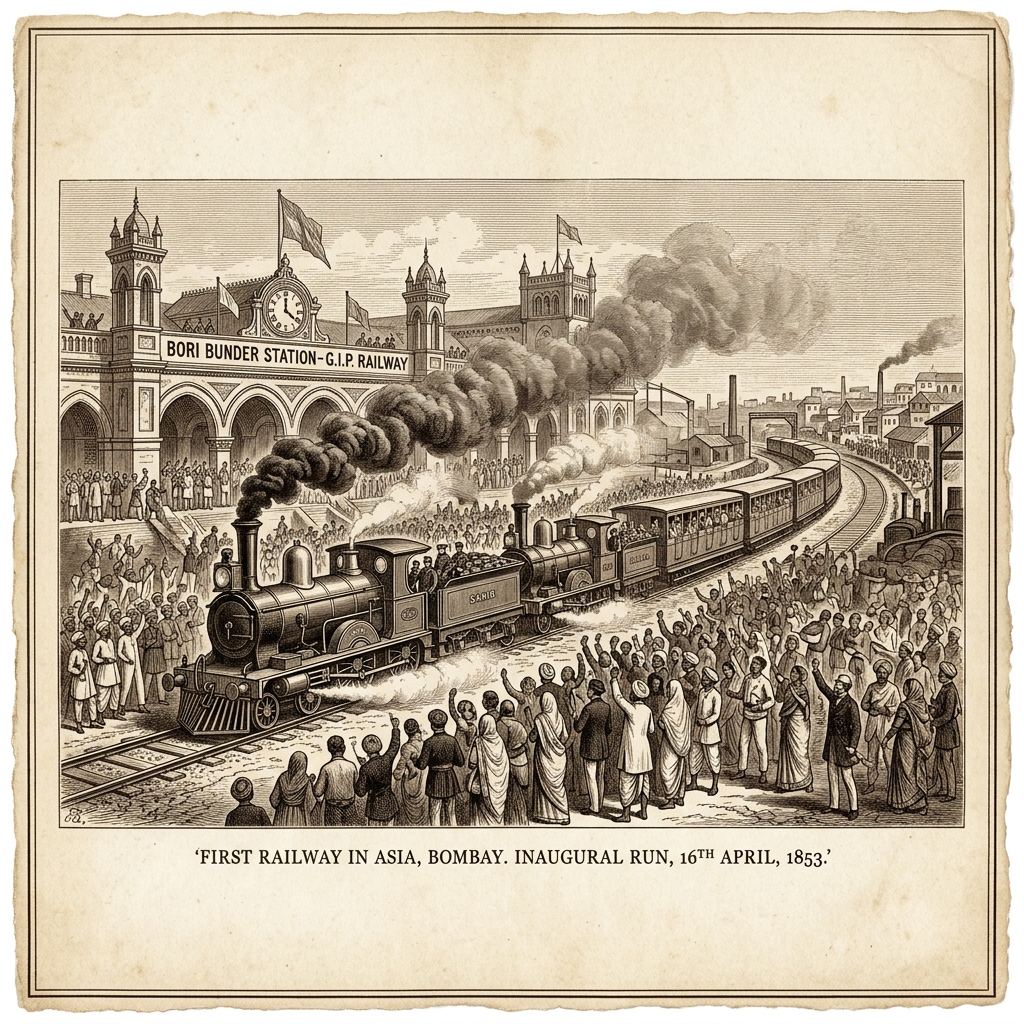
April 16, 1853, stands as a watershed moment in Asian history, marking the dawn of the Railway Age in the East. At 3:30 PM (though some biographical accounts cite 5:00 PM), amidst a thunderous 21-gun salute and the applause of thousands, the first commercial passenger train rolled out of Bori Bunder station towards Tannah (Thane). The train was a magnificent spectacle, comprising 14 carriages (some sources claim 20) and carrying 400 to 500 distinguished invitees, including Lady Falkland, the Governor's wife, and the city's elite.
The train was hauled by three formidable steam locomotives—named _Sahib_, _Sindh_, and _Sultan_—which belched thick smoke into the sultry Bombay sky. For the local populace lining the 21-mile route, the "fire carriages" were a divine miracle. The biography notes that the awe-struck natives dubbed the train _"Chakya Mhasoba"_ (a wheeled deity), applying red _tilaks_ to the smoke stacks, leaving offerings on the footplates, and salaaming the omnipotence of the steam engine. The journey took approximately 1 hour and 15 minutes, a miraculous feat that shrank the vast Indian landscape.
Seated in the first-class carriage was Nana Shankarsheth, holding a specially minted Golden Pass awarded to him by the GIPR in recognition of his foundational role. While British history books often credit Lord Dalhousie as the "Father of Indian Railways," the inaugural run was the physical manifestation of Nana’s decade-long dream. Today, the Central Railway network handles over a trillion passenger-kilometers annually—a staggering evolution from that single, 14-carriage train that Nana helped will into existence.
3. Housing GIPR Engineers in Girgaon Mansion
The logistical nightmare of mapping and constructing India's first railway line required a dedicated base of operations, something the British engineers lacked upon their arrival in Bombay in the late 1840s. When the GIPR's chief engineer, James Berkeley, and his team from the UK-based firm Messrs. Faviel and Fowler arrived to survey the treacherous terrain between Bombay and Kalyan, they faced a severe shortage of adequate office space and residential quarters.
Demonstrating his unwavering commitment to the project's success, Nana Shankarsheth opened the doors of his own palatial mansion (Wada) in Thakurdwar, Girgaon. He provided the British engineers with expansive offices and residential quarters entirely free of charge. This act of immense hospitality and strategic foresight ensured that the preliminary mapping, surveying, and architectural drafting of the railway line could proceed without delay.
Nana’s Girgaon mansion effectively became the very first headquarters of the Indian Railways. It was within the walls of this traditional Maharashtrian Wada that the blueprints for the subcontinent's modern transport infrastructure were drawn. By integrating the British engineering corps into his own home, Nana fostered a collaborative environment that bypassed colonial red tape and accelerated the construction of the railway line, completing it in just 25 months—under budget and ahead of schedule.
4. CSMT Facade Representation
When the Great Indian Peninsula Railway commissioned the young architect Frederick William Stevens to design a new administrative headquarters and terminus in 1878, the result was the Victoria Terminus (now Chhatrapati Shivaji Maharaj Terminus or CSMT). Completed in 1888, this UNESCO World Heritage site is a masterpiece of High Victorian Gothic architecture blended with traditional Indian palatial motifs. To honor the founding fathers of the railway, Stevens incorporated a series of bas-relief medallions on the building's grand facade.
Carved by the renowned sculptor Thomas Earp, these stone medallions feature the busts of the ten original directors of the GIPR. Among the faces of British colonial administrators and aristocrats, the visages of Jagannath Shankarsheth and Sir Jamsetjee Jeejeebhoy are immortalized in stone. Nana’s inclusion as one of the only Indian faces carved into this imperial edifice is a profound testament to his undeniable influence; the British could not erase his role in the railway's creation.
However, modern historians and heritage commentators (as noted in recent digital archives and Instagram reels) point out the spatial politics of this representation. The British figures occupy the central, most prominent portions of the facade, while Nana and JJ are relegated to the sides. Despite this subtle colonial sidelining, Nana’s stone gaze over the city he helped build remains a powerful symbol. He may have been physically sidelined on the facade, but he remains central to the historical heartbeat of Mumbai’s railway network.
5. Bombay Steam Navigation Company (1845/1847)
Nana Shankarsheth’s vision for transport extended far beyond the iron rails; he recognized that Bombay’s true power lay in its maritime dominance. To break the European monopoly on shipping and to facilitate seamless trade along the Konkan coast and beyond, Nana co-founded the Bombay Steam Navigation Company (BSNC). While web sources often cite its founding in 1845, primary biographical records pinpoint its formal establishment to October 29, 1847, with a massive initial capital of 10 lakh rupees.
The BSNC was a revolutionary indigenous enterprise. The board of directors included Nana, Dadabhai Rustamji, Jejeebhoy Dadabhai, and European partners like George Grant. The company launched a fleet of five steamships—_Bombay_, _Dwarka_, _Victoria_, _George Russell Clark_, and _Surat_. These vessels established vital trade routes connecting Bombay to ports in Gujarat (Tankaria, Gogha, Porbandar), Ceylon, and even secured a lucrative government contract (7,500 rupees per month) to run the postal mail service to Karachi.
As a director and trustee, Nana meticulously managed the company's finances, advocating for foresight and reserve funds to protect against the inevitable losses of maritime trade, such as shipwrecks. The BSNC operated successfully for 65 years, laying the groundwork for India's modern coastal shipping industry and proving that native merchants could successfully manage large-scale, mechanized maritime fleets.
6. Trade, Docks, and Cotton Boom
Born into the wealthy Murkute family of goldsmiths and pearl merchants, Nana inherited a vast trading empire that he exponentially expanded. His father, Babul Sheth, had already established a fleet of _Shibbar_ ships (100-ton vessels) trading along the Malabar coast. Nana leveraged this generational wealth to become a central figure in Bombay’s booming export economy, particularly during the mid-19th century.
When the American Civil War halted the export of cotton to England's textile mills, Bombay experienced an unprecedented economic boom. Indian cotton became the lifeblood of the British Empire, and immense wealth flowed into the hands of local merchants. Nana was at the forefront of this economic explosion. He was deeply involved in the Bombay Chamber of Commerce (founded in 1836) and recognized that the city's antiquated docks could not handle the surging volume of trade. He lobbied fiercely for modernized port trust facilities, underground drainage, and the implementation of gas street lighting to allow for safe, round-the-clock movement of goods.
Furthermore, Nana understood that trade required robust financial institutions. He became a pioneer of Indian banking, serving as a founding director for several major banks, including the Bank of Western India, the Commercial Bank of India, and the Mercantile Bank of India. Through these institutions, he facilitated the complex international transactions required for the opium and cotton trades, ensuring that Indian merchants had the capital and credit necessary to compete on a global scale.
7. Toll and Cart Tax Battles
Nana Shankarsheth’s legacy is defined not just by his mega-projects, but by his fierce advocacy for the common man against oppressive colonial taxation. As Bombay’s trade grew, the British administration sought to extract revenue through various municipal taxes, tolls, and cart taxes levied on goods entering the city limits. These tolls disproportionately affected the poor agrarian classes, local farmers, and cart drivers who brought essential commodities from the hinterlands into Bombay.
Utilizing his position in the Legislative Council and the Board of Conservancy, Nana became the de facto legal and public defender of these marginalized groups. He argued vehemently that exorbitant tolls stifled internal trade and punished the very people who fed the city. His deep understanding of local agrarian economics allowed him to dismantle the arguments of British bureaucrats who viewed the native population merely as a revenue stream.
Nana’s battles against these taxes were part of a broader fight for civic rights. Whether he was leading a march of thousands of Koli fishermen to the Governor's mansion to protect the Sonapur crematorium, or fighting against the shackling of native prisoners, Nana consistently used his elite status to shield the working class from colonial extortion. He ensured that the modernization of Bombay’s transport and trade did not come at the cost of its poorest citizens.
8. Media and Video Links
In recent years, the digital age has sparked a renaissance in the appreciation of Nana Shankarsheth’s legacy, with historians and content creators utilizing social media to resurrect his untold stories. A deep dive into web archives reveals a vibrant digital footprint across platforms like Instagram, Facebook, and LinkedIn.
Notable examples include Instagram reels by content creators like @freishia, who explicitly challenges the colonial narrative ("Did the British really start the Indian Railways? Think again!"), highlighting how Nana, JJ, and Perry pushed the East India Company to act. Heritage accounts like @beyond_heritage and @pleachindiafoundation frequently feature the architectural marvels of CSMT, pointing out the "Statue of Progress" and the hidden stone medallions of Nana that millions of commuters rush past daily without noticing. Furthermore, photo-archivists like @chirodeepchaudhuri document the intricate flora and fauna carvings on the terminus, linking them back to the Sir J.J. School of Art—an institution Nana co-founded.
These digital archives, alongside podcasts and digitized philatelic records (such as the 1991 commemorative stamp issued by India Post featuring Nana and the GIPR headquarters), serve a crucial role. They democratize history, translating dense biographical texts into accessible, bite-sized media that educate the modern Mumbaikar about the true, indigenous architect of their city's transport network.
9. Factual Discrepancies & Gaps
When cross-referencing the aggregated web research data with Amar Shende’s primary biography, several notable factual discrepancies and historical gaps emerge that require careful archival reconciliation:
- Founding of the Bombay Steam Navigation Company: Web sources (such as the PMF IAS notes and various Facebook posts) frequently cite the founding of the BSNC as 1845. However, the primary biography explicitly dates the formal establishment of the company to October 29, 1847. It is highly probable that 1845 marks the initial conceptualization and fundraising phase, while 1847 marks its legal incorporation.
- The Inaugural Train's Capacity and Composition: There is a distinct conflict regarding the size of the first train on April 16, 1853. Web articles and social media posts universally claim the train carried 400 passengers in 14 carriages. Conversely, the biography states the train consisted of 20 coaches carrying 500 people.
- Timing of the Inaugural Run: Web sources precisely pinpoint the departure time of the first train from Bori Bunder at 3:30 PM (or 3:35 PM). The biography, however, records the departure time as 5:00 PM.
- Nomenclature of the Railway Association: Web sources frequently refer to the 1843/1845 indigenous effort as the "Indian Railway Association." The biography refers to the initial 1843 syndicate formed by Nana and his peers as the "Great Eastern Railway," which later merged with the London-based "Great Indian Peninsula Railway" (GIPR) in 1849.
These discrepancies highlight the telephone-game nature of digital history versus localized biographical records, emphasizing the need for rigorous cross-examination when documenting the legacy of India's earliest modernizers.